4C Exhibition 2026 Q1 Within the Echoes
Based on this reality of delay and feedback, the exhibition confronts the complexity of their entanglement
Words by Liuxuan Lyu

The group exhibition Within the Echoes opened at 4C Gallery in Los Angeles on January 31, 2026. Bringing together recent works by five contemporary artists, the exhibition does not unfold through a linear narrative. Instead, it constructs a series of perceptual circuits through diverse media. Sound, moving image, text, and spatial structures are repeatedly activated and amplified, rendering viewing less a stable act of observation than an experience oscillating between passivity and agency within a system. Rather than standing outside the works, viewers gradually become aware of their own position from within the echoes.


Beile Hu |Bugtopia
Beile Hu’s sound-and-video installation Bugtopia establishes a viewing relationship that borders on the brutal. The work translates the faint tremors of dying insects into an intense buzzing, filtered through layers of obstruction formed by insect screens, window frames, and a small display. Vision must pass through barriers, while hearing is forced to confront an amplified final moment of life. The window ceases to function as a neutral architectural element and becomes an interface suspended between altar and barrier. Rather than appealing to empathy, the work confronts viewers with a disquieting realization: micro-life forms ignored in everyday human environments often re-enter perception only when technology magnifies them into noise. In Bugtopia, echo does not arise from the repetition of language or image, but from vibrations at the threshold of life, sustained through technological amplification and spatial mediation, enclosing the viewer within an inescapable echo structure.
Xingyu Huang|Beneath Breathing
Xingyu Huang's Beneath Breathing turns attention toward aquatic environments shaped by ongoing human intervention. Avoiding spectacular imagery of ecological catastrophe, the artist edits underwater archival footage to construct a slow yet uneasy visual rhythm. The water depicted is neither purely natural nor fully artificial, but exists in a condition of continual adjustment, repair, and management. “Breathing” here does not signify vitality, but rather the minimum action required to keep a system functioning. Through this restrained approach, the work allows viewers to sense the long-term echoes human actions leave within ecological systems. These echoes do not point to a single event; instead, they accumulate as environmental memory through subtle visual displacements, allowing human intervention to reverberate through water with delay and diffusion.


Xinyun Li |Hubris and Humility— Postures Toward the Land
Li Xinyun’s three digital works, Hubris and Humility — Postures Toward the Land, take architecture as a lens through which to examine modes of human inhabitation. Blueprint of Contained Lives renders skyscrapers as vertical machines, disciplining life into luminous grids; Earthbound returns to low-tech vernacular construction, emphasizing restraint and adaptation; Humble Flow seeks a mode of negotiation between urban systems and natural environments. Rather than presenting oppositions, the three works form a continuous spectrum, suggesting that architecture is not merely a spatial solution, but a posture toward land, risk, and responsibility. Here, echo manifests as the temporal return of architectural choices—each act of conquest, submission, or negotiation re-emerging in the future as structural consequence.
Yanqi He | Complimentary_Machine / The Side Project
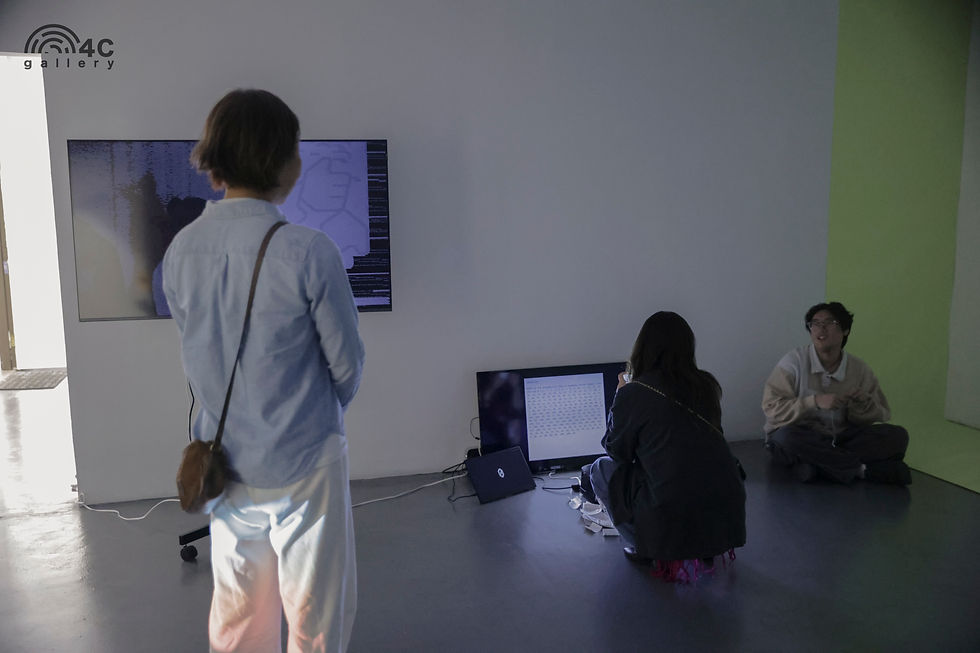
He Yanqi’s complimentary_machine and The Side Project directly address mechanisms of projection embedded in contemporary technological systems. The former subjects a model to extreme alignment training, transforming it into a machine that produces nothing but praise, exposing how the impulse to please becomes encoded within algorithmic weights. The latter strips away assistant structures entirely, forcing the system into recursive collapse within a closed loop. Together, these inverse operations demystify “intelligence,” revealing it as a mirror that continuously reflects human expectation. By refusing spectacle or techno-panic, the works allow the internal logic of computation to surface, exposing a familiarity that is both hollow and unsettling. In this context, echo becomes an internal feedback mechanism through which projection is endlessly amplified, circulated, and distorted.


Ash Wei | Everyday I Consume 2 Pages
Ash Wei’s installation Everyday I Consume 2 Pages approaches information consumption through the body. Text is printed onto slices of bread; reading becomes ingestion, and knowledge a daily “healthy habit.” This seemingly light gesture precisely targets the collusion between self-management and consumer aesthetics in contemporary urban life. Rather than critiquing reading itself, the work materializes text to question whether the constant intake of content produces understanding, or merely new forms of anxiety. Here, echo occurs through bodily ritual: consumed text no longer returns as comprehension, but accumulates as an internal resonance shaped by information, anxiety, and self-discipline.
The works in this exhibition unfold across different scales and media, yet they collectively point to a state of “being within the echo.” Perception is difficult to ascertain in the moment, actions continue to generate effects, and responsibility often lags behind the outcomes. Here, “echo” is not a metaphor, but a structural condition concerning feedback and temporal delay. In a reality where technological, ecological, and social systems are intertwined, we are always situated within the reverberations of our own making. What matters may not be the act of expression itself, but the echoes that have been sent out yet have not yet arrived.
Framing the exhibition around “echo” is not a matter of formal nomenclature, but stems from a judgment about reality. Contemporary experience has long been constituted through delay and feedback. An echo signifies distance and implies responsibility—once it is emitted, a response is already on its way. Rather than focusing solely on the returning sound, it is more productive to attend to that intermediate interval, often imperceptible. Within this span, judgment tends to falter, and the boundaries between subject and system gradually blur.
Based on this reality of delay and feedback, the exhibition does not attempt to depict a harmonious relationship between humans, technology, and ecology. Instead, it confronts the complexity of their entanglement. To be “within the echoes” means we can never stand outside of it. The works do not provide answers, but make this ongoing relational process perceptible, rendering visible the forces that would otherwise remain concealed within time and structure.
Curated by Bingo Fang, Liuxuan Lyu
Art directed by Ash Wei
Presented at 4C Gallery


Our Art Panel
