The Limits of Understanding
Decheng Cui Solo Exhibition
Recognizing that boundary may be where understanding truly begins.
Words by 4C Gallery Curatorial Team

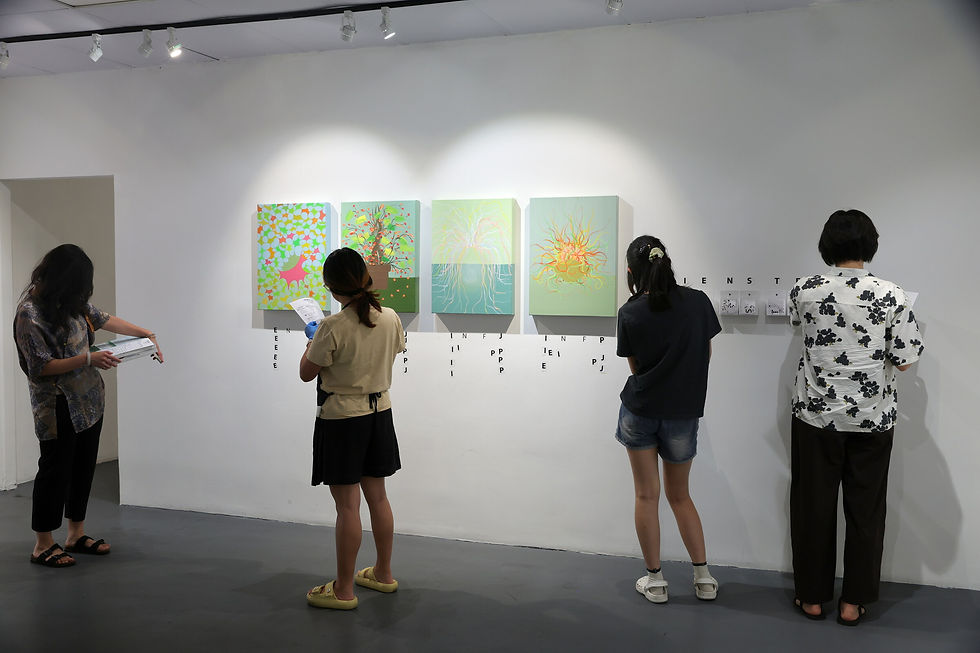
From Aug 9, 2026 through Sep 8, 2026, Los Angeles–based conceptual artist Decheng Cui presents his solo exhibition The Limits of Understanding at 4C Gallery. Comprising sixteen abstract paintings developed through the framework of the sixteen MBTI personality types, a self-portrait, and a participatory system, the exhibition considers the relationships among classification, judgment, projection, and understanding. Rather than offering a conclusion about “how to understand others,” it transforms the gallery into a site where judgments continuously occur, accumulate, and revise one another. Viewers look at the works and leave their choices behind; those choices then become part of the works’ continuing transformation.

Decheng Cui has long lived and worked in Los Angeles, moving among artistic practice, curating, and gallery work. His work has been presented at Google in Silicon Valley, Zolla/Lieberman in Chicago, and CICA Museum in Korea. In recent years, his practice has continued to examine how language, culture, and social experience shape individual cognition. The Limits of Understanding extends this inquiry by placing one of the most common yet easily overlooked acts of daily life—classification—at the center of the relationship between painting and viewing. The exhibition’s sixteen paintings share a common scale and unfold across four color systems: purple, green, yellow, and blue. Their compositional order is related, yet each differs in chromatic density, linear direction, and the relationships among forms, keeping similarity and difference in continual tension.

MBTI is not presented here as scientific truth or a definitive account of personality. What the artist borrows is its highly recognizable language of paired letters in popular culture: E and I, N and S, T and F, J and P. The system is simple enough to create an immediate common vocabulary; precisely because it is so simple, it can also compress a complex person into a few stable symbols. The paintings do not display their assigned types. Viewers must judge through color, rhythm, order, affect, and personal experience. A choice that appears to concern the painting therefore inevitably exposes the viewer’s own patterns of association. When an abstract painting is described as “INTJ-like” or “more ENFP,” are viewers recognizing something in the image, or projecting familiar experience onto it?

At the exhibition, visitors choose one letter from each of four opposing pairs and place the four stickers on the works they believe correspond to those traits. The project offers no answer key and does not use the final vote to prove that a work belongs to a particular personality type. A sticker is first a judgment and only then a visible record. As participation grows, the formerly intact paintings are gradually covered by different letters, transforming individual decisions into an expanding map of collective cognition. Some works produce relative agreement; others receive mutually contradictory labels. The former are not therefore closer to truth, nor do the latter signal a failure of communication. Together, these outcomes reveal that “consensus” is often not an inherent property of the object, but a temporary structure formed within a particular group, language, and field of experience.
The Limits of Understanding therefore addresses more than the single question of whether a classification is correct. It asks when classification helps communication and when it begins to substitute for the object itself. Labels can provide an entry point into dialogue, yet they can also acquire excessive authority: we first use them to approach an unfamiliar subject, then confine that subject within the limits of what the label permits. The exhibition retains the efficiency of classification while making its limits visible. Each letter a visitor applies describes the work, but also marks the viewer’s own way of organizing the world. The artwork is no longer a static object awaiting interpretation, and the viewer is no longer merely an observer at its edge. The two enter a temporary relation of co-authorship, while “understanding” shifts from possessing the object to recognizing one’s own position.

Within today’s highly polarized public sphere, this mechanism points beyond personality testing itself. Social media, political discourse, and narratives of identity continually compress complex experience into positions that can be recognized at a glance, making it easier to manufacture divisions between “us” and “them.” When classification shifts from a tool of recognition into a boundary between camps, difference can be interpreted as threat, and disagreement can become exclusion before it has been adequately understood. The exhibition does not eliminate positions or ask viewers to suspend judgment. Instead, it asks whether judgment can retain an awareness of its own limits, whether understanding can exist without requiring agreement, and whether people can first acknowledge differences in experience, history, and position before conflict hardens into hostility.
As judgments continue to adhere to the surfaces over the course of the exhibition, the works shift from paintings completed by the artist into social surfaces marked collectively by many participants. The overlapping, divergent, and contradictory letters record not only how viewers understand the works, but also how understanding is shaped by experience and group relations. For Decheng Cui, mature understanding may not mean the disappearance of boundaries; it may mean remaining willing to look, listen, and revise even after acknowledging them. Recognizing the limits of understanding is not a reason to stop trying. It is what allows understanding to move beyond a premature conclusion and become an ongoing relationship.



About Artists
Feiyu Feng is a visual artist working at the intersection of photography and cinematography, crafting imagery that feels both intimate and cinematic. With a background that bridges both mediums, she distills personal experience into minimalist visual narratives, capturing the emotional resonance of fleeting moments with quiet intensity. Her work is an exploration of womanhood—its contradictions, its quiet power, its vulnerability. The women she portrays are complex and multifaceted, embodying a spectrum of emotional truth: fierce yet fragile, grounded yet ethereal.
Feng’s restrained compositions emphasize subtlety over spectacle, inviting the viewer to lean in and linger. Her storytelling leaves space for ambiguity, where what is unspoken becomes as meaningful as what is seen. Influenced by the quiet dramas of daily life, she uses softness and stillness as tools of revelation. In her hands, the camera becomes less a recorder and more a listener—bearing witness to the unsaid, the unseen, the beautifully unresolved.
About Artists
Born in 1990, Decheng Cui is a multidisciplinary artist whose practice confronts the fear of death and the inevitability of physical mortality. He sees art as a means of embedding fragments of the self within human civilization, allowing traces of the individual to take root beyond the limits of the body. For this reason, medium is secondary to the ideas and inner world carried by the work.
His ongoing Metaphysical Series consists of four chapters that examine opposing and often contradictory perspectives. Rather than presenting a single worldview, he places conflicting positions alongside one another, allowing each to be reconsidered through the perspective of its opposite. Against a contemporary backdrop of increasing social fragmentation and anti-globalization, his work seeks to create space for different worldviews to coexist and for mutual understanding across ideological divides.
Working across painting, printmaking, fiber, sculpture, performance, animation, and sound, he adopts different artistic languages according to the conceptual needs of each work.